









Chinese Lanterns: From Ritualistic Luminescence to the Illumination Epic of Smart Cities
Author:
Source:
Release time:2026-03-09

China in a Single Lamp
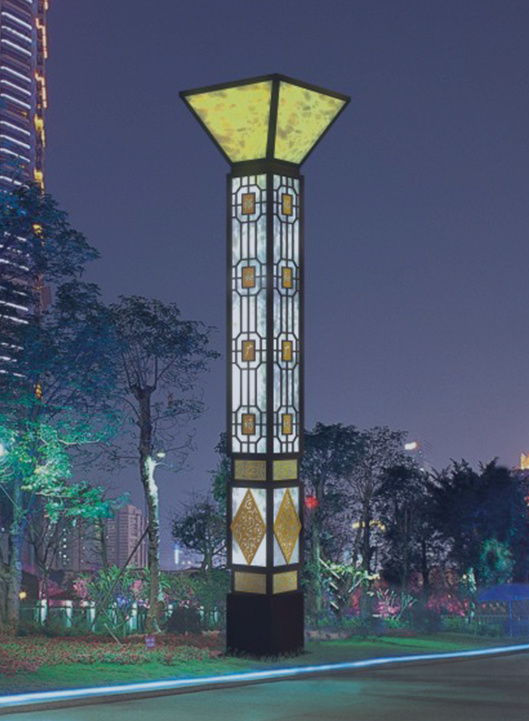
When night falls, standing on Beijing's Chang'an Avenue or in a county town's
cultural square, we always see those with dignified designs,
multi-flame, linked Chinese lamps. They are not only tools for illuminating
the roads, but also a silent cultural expression.
The history of Chinese lamps is far weightier than we imagine—
from the Chu Ci's wording "Hua Deng Cuo Xie" in written records,
to the national image symbol in Tiananmen Square,
and to today's smart terminals carrying 5G base stations,
this lamp has, over more than two thousand years,
become a microcosm of China's lighting history.

Changxin Palace Lamp: a Han-era precursor to environmental thinking
When discussing the spiritual origin of Chinese lamps, one must mention the
Western Han Changxin Palace Lamp, hailed as "China's First Lamp."
In 1968, this national treasure unearthed from a Han tomb in Mancheng, Hebei,
demonstrated to the world the foresighted design intelligence of the ancient Chinese.
This gilt-bronze lamp, 48 centimeters tall, depicts
a barefoot, kneeling palace maid holding a lamp. Its ingenuity
lies not only in its graceful form but also in the embedded
ingenious "black tech": the oil smoke produced by combustion passes through the maid's
right arm into the hollow body, cools and condenses at the base of the lamp,
thus keeping indoor air clean. The lampshade is composed of two arched
panels that can open and close freely to adjust the direction and brightness of the light.
After visiting, former U.S. Secretary of State Henry Kissinger remarked, "China
had environmental awareness as early as the Han dynasty more than two thousand years ago." In fact,
it was not until the 15th century that Leonardo da Vinci invented a similar
sheet-metal smoke-guiding lampshade—more than 1,500 years later than the Changxin Palace Lamp.
This design concept of "objects conveying values" laid the foundation for
the spiritual tone of Chinese lamps—they have never been merely lighting
tools, but a fusion of technology and the humanities.

Modern Chinese Lamps: five generations over fifty years
If the Changxin Palace Lamp represented the pinnacle of classical Chinese lamps,
then modern Chinese lamps have undergone even more dramatic technological iterations.
First generation (early years of the PRC): under Premier Zhou Enlai's personal attention,
Chinese lamps began to adorn Tiananmen Square and Chang'an Avenue. At that time,
Chinese lamps "prioritized decoration over function," serving more as
a cultural symbol of the national image.

Second generation: after the Reform and Opening-up, with urban expansion, lighting demand
increased sharply. Manufacturers raised brightness by adding external floodlights,
but high energy consumption and poor light distribution problems followed. By
the turn of the century, there were even calls to "abolish Chinese lamps."
Third to fifth generations (2010s to present): LED technology
brought a turning point. The latest fourth-generation Chinese lamp
uses a "cut-off high-polarization integrated LED spherical lamp",
merging decorative light sources with primary illumination and raising luminaire efficiency
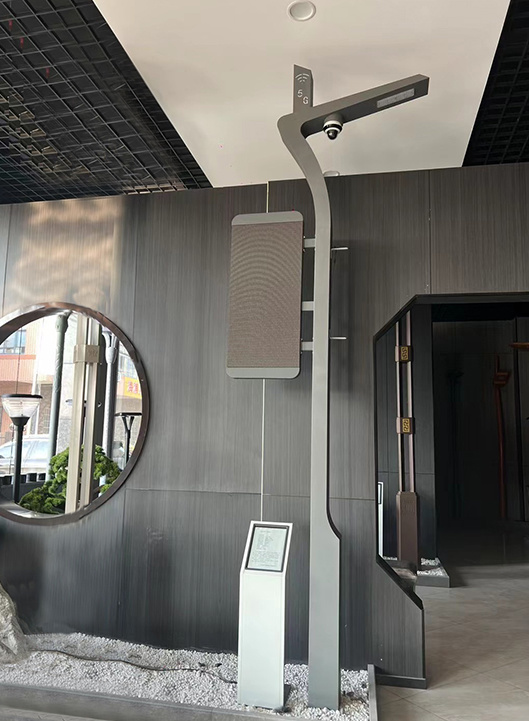
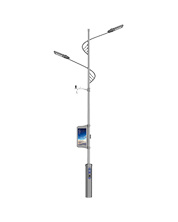
from around 20% to over 80%. The fifth-generation "smart Chinese lamp"
can already carry 5G micro base stations, environmental monitoring, traffic surveillance,
and other modules, truly achieving "multiple uses in one pole."

Current dilemmas and preservation
Technological progress has not solved all problems. In Liaocheng,
municipal authorities are replacing Chinese lamps on some road sections
with integrated LED fixtures because traditional Chinese lamp light sources
have defects; in Jianghua Yao Autonomous County, 91 Chinese lamps
are undergoing modifications under the principle of "preserve the classic, renovate internally"—
keeping traditional shapes while retrofitting new energy-saving light sources.

These cases reflect the real predicament of Chinese lamps:
as cultural carriers, they bear citizens' emotional
attachment and the city's aesthetic expectations; as functional facilities,
they must meet strict energy-saving targets and lighting standards.
How to strike a balance between "beautiful" and "practical",
is a question every city using Chinese lamps must answer.
From the Changxin Palace Lamp's smoke removal and dust prevention to the environmental
monitoring of smart lamps, the historical evolution of Chinese lamps reflects the Chinese people's
relentless pursuit of a better life. They have witnessed our
transition from kneeling on mats to strolling the streets, and they also carry
the value shift from ritual order to public service.
When we gaze up at those warm halos of light in the night,
Perhaps we should remember: this is not just light—it is more than that.
A nation that has spent two thousand years writing…
An epic about civilization and wisdom.

Guangdong Quanhui Lighting Co., Ltd. Founded in 2004, it is a comprehensive lighting enterprise integrating production, sales, and installation.
21 years of dedicated production: Municipal streetlights 、 Landscape lighting 、 Courtyard lights 、 High‑pole light fixture 、 Smart Streetlights Outdoor landscape lighting projects.
Related News
Guangdong Quanhui Lighting Co., Ltd
Phone : 86-13726017260 Mr Li
WhatsApp:+86-18028366908
E-Mail: 18028366908.qh@gmail.com
Website : www.quanhuilight.com
Address of exhibition hall : cards 28, 29 and 30, building c, international street lamp city, guzhen town, Zhongshan city, Guangdong province
Factory address : No.17 and 18 Jiwei Avenue, Haizhou Xianlong Luo Sha Jiwei Industrial Zone, Guzhen Town, Zhongshan City, Guangdong Province
Leave us a message.