









A Magnolia Lamp, Half a City’s Splendor: A Brief History of the Aesthetic of Chinese Urban Street Lighting
Author:
Source:
Release time:2026-04-21

A Leap from Lighting Tool to Cultural Symbol
On the streets of Chinese cities, few public facilities
Like the magnolia lamp, it not only serves the practical function of illumination,
It also carries the collective aesthetic memory spanning half a century.
This elegantly designed streetlamp has long since transcended the mere function of “illuminating the road.”
Its original function has transformed it into an ever-blooming “magnolia” in the urban space.

Origins of Form: An Eastern Design Language Inspired by Nature
The design of the Magnolia Lamp draws inspiration from the blossoming form of the white magnolia flower.
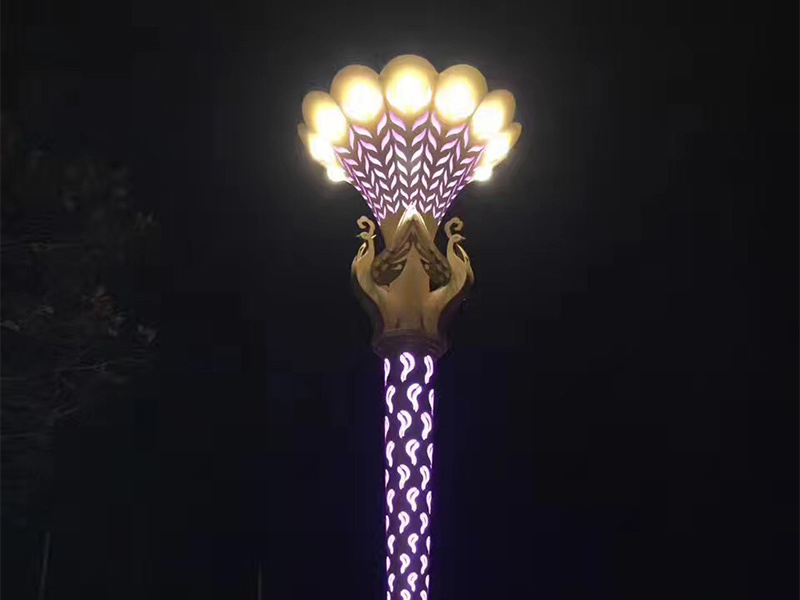
The lamp head consists of multiple petal-shaped shades that unfold in layers,
Like a budding or fully bloomed magnolia. This design is not
By chance—the white magnolia, as a renowned traditional Chinese flower,
Endowed with symbolic meanings of purity and steadfastness, it is integrated into lighting design,
It embodies the Eastern aesthetic principle of “learning from nature.” Compared with Western streetlights,
While emphasizing the modernity of geometric lines, the magnolia lamp retains the essence of plants.
The vitality of upward growth is expressed through industrial aesthetics via metallic materials.
While maintaining precision, it also preserves the gentle warmth of natural imagery.

In 1978, this type of sculptural streetlight was installed for the first time on the Bai Causeway at West Lake in Hangzhou.
At the time, designer Hua Maochang’s original intention was simple: to create within the West Lake Scenic Area.
Create a quiet, elegant nighttime ambiance. They chose the white magnolia,
Because “they felt that the magnolia blossoms best complemented West Lake.” This choice later
Proven to be remarkably visionary—Yulan lamps have since spread from the shores of West Lake to the entire nation.

Structural Aesthetics: The Invisible Ingenious Design
The allure of the magnolia lamp goes beyond its appearance. The true lighting core
It is not those few conspicuous “magnolias,” but rather what lies hidden beneath the “petals”—
Downward-facing luminaires. This concealed design is remarkably sophisticated:
The magnolia ball at the top serves as an accent piece and does not require a high-wattage light source.
What truly lights the way are those “leaves” that hardly look like lamps at all.
By day, it serves as a scenic sculpture at the street corner; at night, it transforms into a gentle gaze that softly illuminates the pavement.
Hangzhou’s earliest white magnolia lantern stands 5.5 meters tall, with the flower and its support structure adding another 1.6 meters.
One lamp is installed every 25 meters—these figures are based on the road conditions at the time.
The precise measurements of the length and width, as well as the height of the willow trees along the shores of West Lake.
Every detail has been carefully considered: the floral receptacle is chosen in a pale green to complement the surroundings.
The design is harmoniously integrated with the environment, and the white glass lampshade ensures soft, diffused lighting.

A Carrier of Memory: Urban Nostalgia Across Generations
For many Chinese, the magnolia lantern is a city symbol etched into their memories.
The 299 magnolia lamps on the Nanjing Yangtze River Bridge once appeared in primary school textbooks.
Becoming a visual symbol of the nation’s image. On Baisha Road in Hangzhou The remaining 9 lamps
The magnolia lamps, meanwhile, have been preserved as witnesses to the city’s history.
An elderly resident of Hangzhou recalls that in the 1980s, many couples would spend their evenings in
Under the soft glow of the magnolia lamps, couples stroll arm in arm—such was an era.
These everyday scenes are also the most authentic urban memories of ordinary people.
The magnolia lamp has witnessed China’s urban transition from tradition to modernity.
It has graced the halls of the capital and now reaches the everyday journeys home of ordinary people.
From Beijing’s Chang’an Avenue to the Nanjing Yangtze River Bridge, from Hangzhou’s West Lake To Huarong in Ezhou,
This “magnolia” is found all over the country. It has taken root, becoming a shared visual memory for generations.

Technological Evolution: Rebirth Through Heritage
Early magnolia lamps were far from perfect. The first-generation product in 1978,
The glass lampshade is not sealed tightly against the lamp base, making it easy for insects to be attracted.
“It needs to be cleaned every other day”; cast-iron lampposts are also prone to rusting. Later,
The flower holder has been upgraded from iron to aluminum, and the mounting screws have been replaced with copper, reflecting continuous improvements in materials and manufacturing processes.
Entering the 21st century, magnolia lamps have undergone technological iteration. In 2018, Nanjing
During the renovation of the Yangtze River Bridge, all 299 magnolia lamps were replaced with LED cold-light sources.
LED beads are embedded beneath the ring-shaped luminaire, increasing the average road surface illuminance from 3 lux.
Increasing the illuminance to 25–30 lux actually reduces energy consumption by 80%.
In early 2026, Ezhou, Hubei Province, completed the installation of 510 sets of magnolia-style modular lighting fixtures.
Citizens commented, “It’s bright and beautiful—walking outside at night feels much safer now.”

Cultural Renewal: From Universal Symbols to Urban Branding
In recent years, the magnolia lamp has entered a new stage of development—moving away from “standard models” and
Toward “customization.” Localities are beginning to incorporate indigenous cultural elements into design:
The magnolia lamps in Shenmu, Shaanxi Province incorporate apricot blossom motifs, the city’s logo, and
The city spirit of “loyalty and courage, innovation”; the “Magnolia Embroidering Spring” festival on Huaihai Road in Shanghai
The lighting fixture employs “breathing” rhythm technology, with its base inspired by the “dragon-shaped jade ring” from ancient jade artifacts.
its design; in Shimen, Hunan, tea culture has been integrated into the design of streetlight poles.
This transformation reflects the evolution of China’s urban development philosophy:
From “functional” to “aesthetically pleasing,” and then to “meaningful.”
City managers have realized that even in the most utilitarian urban elements,
It also holds the potential for aesthetic pursuit and cultural inheritance.

A streetlamp can serve as a city’s calling card.
The evolution of the magnolia lamp reflects the shift in Chinese cities from a function-oriented approach
To the holistic transformation of cultural expression. In the pursuit of a highly efficient and intelligent future.
In cities, how can we strike a balance between technological innovation and traditional aesthetics, and how can we ensure that public
The facilities meet modern needs while preserving a human touch—Magnolia Lights.
The evolution of [it] provides a case worthy of deep reflection. As night falls,
The glowing “magnolia” at the street corner lights up, illuminating not only the path home,
There is also a city’s aesthetic aspirations and cultural confidence.

Guangdong Quanhui Lighting Co., Ltd. Founded in 2004, it is a comprehensive lighting enterprise integrating manufacturing, sales, and installation.
21 years of dedicated manufacturing: Municipal streetlights 、 Landscape lighting 、 Courtyard light 、 High-mast light 、 Smart Streetlights Outdoor landscape lighting and illumination project.
Related News
Guangdong Quanhui Lighting Co., Ltd
Phone : 86-13726017260 Mr Li
WhatsApp:+86-18028366908
E-Mail: 18028366908.qh@gmail.com
Website : www.quanhuilight.com
Address of exhibition hall : cards 28, 29 and 30, building c, international street lamp city, guzhen town, Zhongshan city, Guangdong province
Factory address : No.17 and 18 Jiwei Avenue, Haizhou Xianlong Luo Sha Jiwei Industrial Zone, Guzhen Town, Zhongshan City, Guangdong Province
Leave us a message.