









The wall is paper, the light is ink: The interplay of attachment and autonomy in outdoor wall‑lamp design.
Author:
Source:
Release time:2026-08-31

The Wisdom of Attachment: The Symbiotic Relationship Between Wall Lamps and Walls
The fundamental logic behind outdoor wall‑light design lies in a profound understanding of the relationship of “attachment.”
It differs from the freestanding design of courtyard lights and from the low‑profile, ground‑level placement of lawn lights.
Wall lamp It always maintains a symbiotic relationship with the vertical interface—growing out of the wall,
It redefines the wall once again. This kind of attachment is not a passive hanging on the wall, but rather…
Actively responding to the wall’s materiality, scale, and architectural language. On the stone‑masonry façade,
The base of the wall lamp should engage in a dialogue with the stone’s texture; in a brick‑wall setting, the luminaire…
The rhythm of the lines and the brick joints creates a visual echo. Can a wall lamp harmonize with the architecture?
“Growing together” depends on whether its form, proportions, and texture are in harmony with…
The wall surface forms an organic continuum, rather than a rigid attachment.

The Vertical Narrative of Light: The Spatial Defining Power of Wall Lamps
The design depth of a wall lamp is reflected in how it redefines space through light.
Horizontal illumination is provided by overhead and street lamps, while vertical illumination serves a narrative function.
is the exclusive domain of wall lamps. By precisely controlling the beam angle and the direction of illumination,
Wall lamps can create rich layers of light and shadow on the wall—casting light that sweeps across the surface.
Wall-washing light can accentuate the rough texture and intricate grain of stone; it is directed downward.
The directional beam delineates the boundaries of the entrance and the passageway, creating a clear…
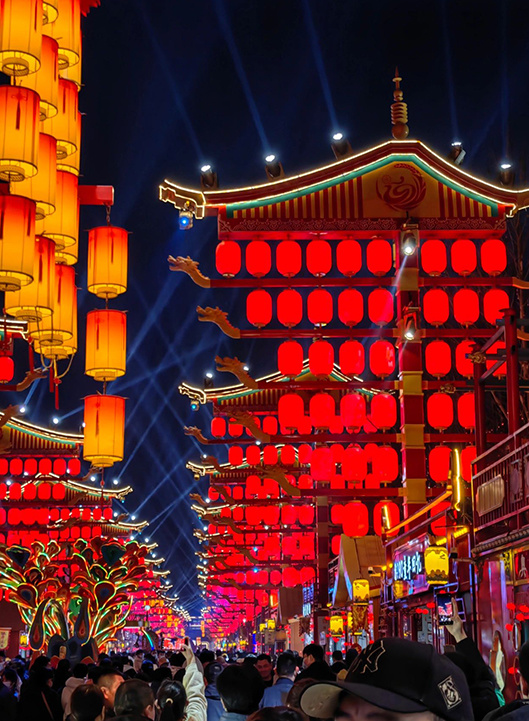
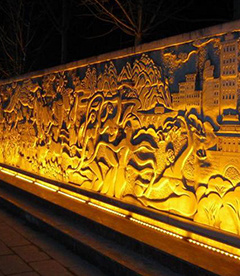
Visual guidance. In the lighting design of Qixia Street in Weihai, custom wall lamps are used to…
By controlling the vertical illuminance distribution and the projection direction, a directional light sequence is established.
It transforms wall lamps from isolated sources of light into orchestrators of spatial rhythm.

Style and Grammar: From Classical Ornamentation to Modern Minimalism
The formal language of outdoor wall lamps has exhibited a distinct stylistic evolution across different historical periods.
Classical-style cast-iron wall lamps are characterized by decorative motifs such as scrolling foliage and acanthus leaves.
Emphasizing a handcrafted quality and historical depth; in the Neoclassical period, the focus shifted to proportion.
In pursuit of symmetry, forms tend toward simplicity and solemnity; since the advent of modernism,
Minimalist geometric forms have become mainstream, with designers placing greater emphasis on the lamp’s volumetric presence.
Composition and material contrast. This evolution is not merely a change in form, but rather…
A profound shift in design philosophy, from “decorating walls” to “defining walls.”
Contemporary outdoor wall lamp designs place greater emphasis on the integration of the fixture with the building façade, in terms of color,
In terms of scale and installation method, it seeks to achieve visual harmony with the wall.

The Human-Centered Dimension: Considerations of Height and Rhythm
The design of outdoor wall lamps is distinctive because it naturally resonates with human scale.
It is typically installed at eye level or slightly above (approximately 2.5 to 3 meters), aligned with the human line of sight.
A relationship akin to dialogue is established—between looking up and down, as one walks,
The change in light is synchronized with human perception. This high-level configuration determines the wall lamp’s…
The beam angle requires precise control to prevent direct illumination of the eyes, which can cause glare.
It is also necessary to ensure that the ground has sufficient illumination to meet safety requirements. Wall lamps are used outdoors.
Another consideration in the environment is the circadian rhythm of light color and brightness. Warm color temperatures…
Light (2700K to 3000K) is more in line with human physiological perception at night and can
Create a quiet, cozy nighttime ambiance, while light with an excessively high color temperature can be disruptive.
The comfort and sense of tranquility of outdoor spaces. The design depth of the wall lamp, ultimately…
It is reflected in its understanding and balance of the relationship among people, walls, and light.

Guangdong Quanhui Lighting Co., Ltd. Founded in 2004, it is a comprehensive lighting enterprise integrating manufacturing, sales, and installation.
21 years of dedicated manufacturing: Municipal streetlights 、 Landscape lighting 、 Courtyard light 、 High-mast light pole 、 Smart streetlight Outdoor landscape lighting project
Related News
Guangdong Quanhui Lighting Co., Ltd
Phone : 86-13726017260 Mr Li
WhatsApp:+86-18028366908
E-Mail: 18028366908.qh@gmail.com
Website : www.quanhuilight.com
Address of exhibition hall : cards 28, 29 and 30, building c, international street lamp city, guzhen town, Zhongshan city, Guangdong province
Factory address : No.17 and 18 Jiwei Avenue, Haizhou Xianlong Luo Sha Jiwei Industrial Zone, Guzhen Town, Zhongshan City, Guangdong Province
Leave us a message.