









High-Mast Lighting: The Engineering Logic from Centralized Illumination to System Nodes
Author:
Source:
Release time:2026-09-21

The Inevitable Choice of Lighting Methods
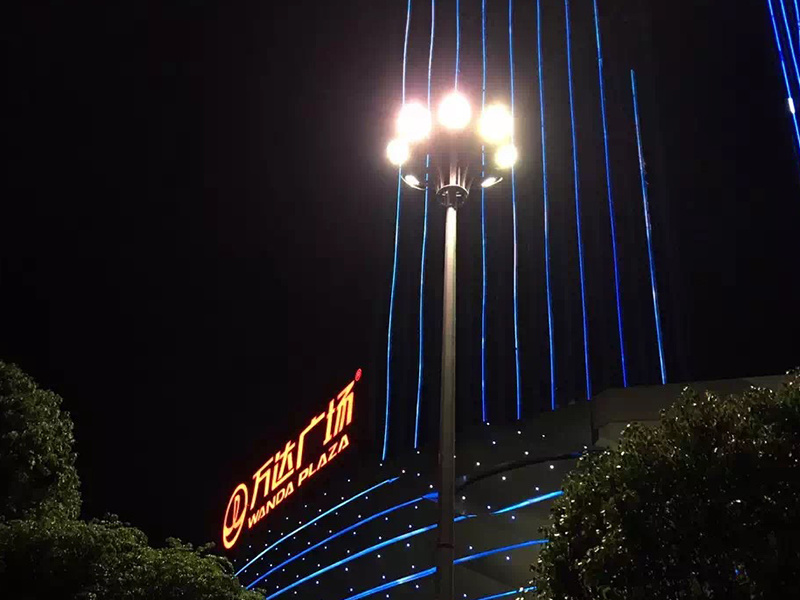
High-mast lighting fixtures typically refer to steel‑structured luminaires with heights exceeding 15 meters, and their core value is…
It lies in resolving a specific spatial contradiction: when the illuminated area is extremely large,
When ground-level facilities are densely clustered or the spatial configuration is complex, conventional streetlights struggle to…
Achieve uniform coverage with an appropriately optimized deployment density. Airport aprons, port storage yards,
Large overpasses, sports venues, and other such facilities are precisely where high-mast lighting is effectively utilized.
A typical domain of establishment. Its design logic is not “the higher, the better.”
Instead, it trades height for a larger coverage radius and replaces dispersed lighting points with concentrated installations, thereby…
While meeting illumination standards, reduce the number of light poles to minimize disruption to ground-level activities.

Lifting System: Maintenance Logic Determines Structural Form
In the design of high-mast lighting, the most critical engineering challenge is “how to facilitate maintenance.”
The lamp panel is installed at an altitude of several tens of meters; any failure of the light source or electrical maintenance, if reliant on…
Climbing or using aerial work platforms entails costs and risks that are difficult to bear. Elevating light‑up panels.
Its emergence has fundamentally transformed the structural logic of high-mast lighting. By incorporating an internal…
Winch and traction steel cable; the lamp panel can be lowered to approximately 2.5 meters above the ground for maintenance.
Personnel can complete luminaire replacement and commissioning from the ground. This design choice is counterintuitive.
It determines the internal structure of the pole—the electrical control system and the lifting mechanism are…
It is mounted on the inner lower portion of the pole to protect the precision components from wind and weather, while…
This makes the lamp post itself a composite system integrating structural, mechanical, and electrical components.

Optical Constraints: The Engineering Baseline for Anti-Glare Design
The optical design of high-mast lighting fixtures faces an inherent trade-off: the more concentrated the light source and the higher its power,
The larger the size, the stronger the coverage; however, the risk of glare also increases. Relevant design considerations.
The standard explicitly stipulates that the angle between the direction of maximum luminous intensity of high-mast lighting fixtures and the vertical line is…
It should not exceed 65 degrees to control light spill above the horizontal plane.
In scenarios such as airport aprons where glare sensitivity is extremely high, this constraint…
More stringent—cut-off optical design requires luminaires to be positioned at an elevation angle of 0 degrees or greater.
No light output, preventing glare from shining toward the control tower and interfering with aircraft takeoff and landing observations.
The approach to glare reduction has evolved from early methods such as tilted mounting to the use of polarizing lenses.
By adjusting the exit angle, the light can be directed horizontally and then projected downward—this represents a technological advancement.
The guiding principle has always been to direct light “where it belongs,” rather than simply increasing its power.

Structural Consciousness: The Logic of Safety Under Wind Loads
The wind‑resistance design of high‑mast lighting represents another engineering hurdle that sets it apart from conventional streetlights.
The bending moment experienced by a pole tens of meters tall in strong winds is far greater than that of a low‑lying light pole.
The pole body typically employs a polygonal‑section, tapered steel pole with a fully spigot‑and‑socket connection and no transverse welds.
The manufacturing process ensures structural continuity and straightness. The lamp panel is lightweight.
It likewise serves the purpose of wind resistance—featuring a hot-dip galvanized steel conical frame,
While ensuring structural strength, reduce the weight of the lamp panel and minimize its wind‑resistance area, thereby optimizing the high‑mast lighting fixture.
It maintains structural integrity and stable illumination even in extreme weather conditions. The high-mast light’s…
The depth of the design ultimately hinges on a straightforward engineering judgment: it must be able to…
Unmanned, at an altitude of dozens of meters, it endures wind and weather while continuously fulfilling its mission.

Guangdong Quanhui Lighting Co., Ltd. Founded in 2004, it is a comprehensive lighting enterprise integrating manufacturing, sales, and installation.
21 years of dedicated manufacturing: Municipal streetlights 、 Landscape lighting 、 Courtyard light 、 High-mast light fixture 、 Smart streetlight Outdoor landscape lighting project
Related News
Guangdong Quanhui Lighting Co., Ltd
Phone : 86-13726017260 Mr Li
WhatsApp:+86-18028366908
E-Mail: 18028366908.qh@gmail.com
Website : www.quanhuilight.com
Address of exhibition hall : cards 28, 29 and 30, building c, international street lamp city, guzhen town, Zhongshan city, Guangdong province
Factory address : No.17 and 18 Jiwei Avenue, Haizhou Xianlong Luo Sha Jiwei Industrial Zone, Guzhen Town, Zhongshan City, Guangdong Province
Leave us a message.