


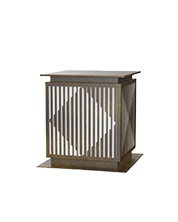




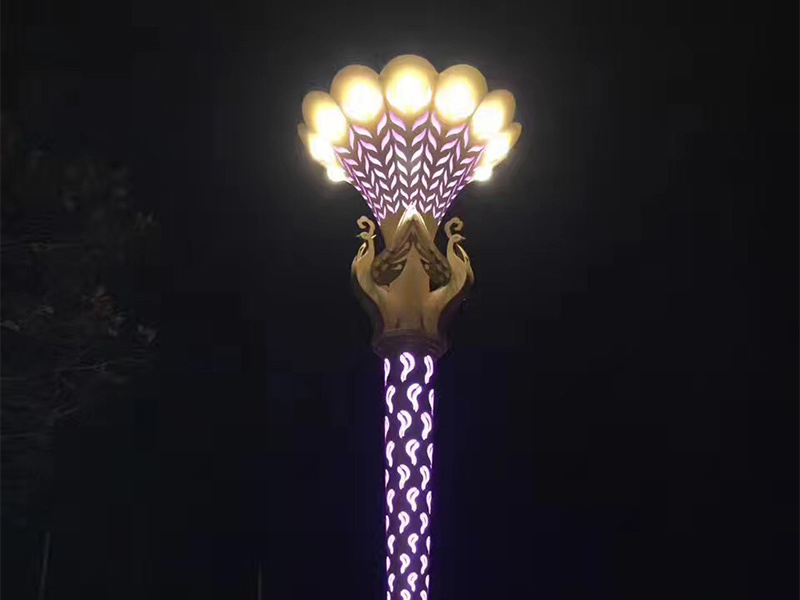




Chinese‑Style Outdoor Wall Lamp: A Translation of Form and the Cultural Nuance of Light
Author:
Source:
Release time:2026-11-02

From “Chinese Elements” to “Chinese Logic”
The design dilemma of Chinese-style outdoor wall lamps does not stem from a lack of “Chinese elements,” but rather from…
Most works reduce Chinese motifs to adhesive decorative symbols—such as antique-bronze‑colored spray finishes,
Marble lampshades and laser-cut fretwork panels—these techniques in themselves are perfectly acceptable,
The problem is that they are treated as “style labels” rather than “design logic.”
Usage. In the application materials for a new Chinese‑style wall lamp, the designer describes their design concept.
For “employing modern craftsmanship and materials while incorporating classical Chinese cultural elements,” surface treatment.
It employs a copper‑like brushed finish to create a “classical aesthetic with a sense of timeless history.”
This statement reflects the typical trajectory of current mainstream practice: taking material and pattern as…
The primary means of cultural translation. However, what truly warrants inquiry is the Chinese-style wall lamp.
Can cultural identity be affirmed only by “appearing to be an antique,” or…
There exists a deeper path that proceeds from the logic of spatial relationships and the behavior of light.

Vertical Restraint: A Proportional Dialogue Between Wall Lamps and Architecture
In the linguistic system of Chinese architecture, vertical composition occupies a central position—columns, beams,
The lintels and window lattices alike all organize their forms along the vertical axis. The Chinese-style outdoor wall lamp…
Formal selection should echo this vertical logic, rather than adopting a horizontally expansive approach.
The design disrupts the rhythm of the wall. In practice, wall lamps are often mounted on the side of courtyard columns or…
Beside the lintel, adjust the “vertically composed shot with balanced proportions” and the “30° slightly downward‑tilted lighting angle.”
It causes the halo to spread gradually along the column shaft rather than radiate outward in all directions. This light‑emission pattern aligns with…
The Chinese architectural preference for “subtlety”: light does not proclaim its presence, but rather…
The technique of glancing shots reveals the textures of materials— the cracks in the blue bricks, the brass clasps on the wooden doors,
Chisel marks on the stone pillar. Here, the wall lamp serves not as a decorative element for the wall.
An attachment, but rather a medium that allows the building to “continue speaking” at night.

The Temperature of Light: The Cultural Foundations of Color-Temperature Selection
The selection of optical parameters for Chinese-style outdoor wall lamps likewise reflects cultural considerations.
The faux marble cover, paired with a 3000K warm‑tone light source, is explicitly described by the designer as “creating an atmosphere that aligns with”
“The soft and warm visual effect of Chinese aesthetic sensibilities.” This judgment deserves serious consideration:
Chinese‑style spaces have always favored a warm, gentle light over one that is stark and austere, and subtlety over directness.
When warm‑toned light sources are diffused through marble or faux sheepskin material, they neutralize the inherent point‑source character of LEDs.
A characteristic that gives light a diffused, almost moonlit quality. Some users…
It describes the experience as “like moonlight gently filtered through a sheer veil.” Though this description comes from an individual…
Human perception, however, points to a design proposition: the light of a Chinese‑style wall lamp should evoke associations.
What matters is the behavior of natural light within a traditional space, rather than the technical specifications of artificial lighting.

Durability is sincerity.
Chinese-style outdoor wall lamps must ultimately withstand the elements and the passage of time. They feature IP65‑rated waterproof sealing and an aluminum alloy construction.
Or made of all‑copper material with weather‑resistant coating—these engineering specifications are often simplified in marketing contexts.
As “selling points,” yet from a design‑ethics perspective, they point to a more fundamental question:
A lamp mounted on someone else’s wall—does it truly convey sincerity five or ten years down the line?
It still retains the original form and light quality envisioned at the design’s inception. The copper develops a bluish-gray patina when exposed to the elements.
The rust layer has been described as “a seal of time”; this characterization holds true only on the condition that…
It is the material itself that can withstand oxidation without deteriorating. The cultural expression of Chinese wall lamps,
Ultimately, it cannot escape the most fundamental quality of an object: it must stand the test of time.

Guangdong Quanhui Lighting Co., Ltd. Founded in 2004, it is a comprehensive lighting enterprise integrating manufacturing, sales, and installation.
21 years of dedicated manufacturing: Municipal streetlights 、 Landscape lighting 、 Courtyard light 、 High-mast light fixture 、 Smart streetlight Outdoor landscape lighting project
Related News
Guangdong Quanhui Lighting Co., Ltd
Phone : 86-13726017260 Mr Li
WhatsApp:+86-18028366908
E-Mail: 18028366908.qh@gmail.com
Website : www.quanhuilight.com
Address of exhibition hall : cards 28, 29 and 30, building c, international street lamp city, guzhen town, Zhongshan city, Guangdong province
Factory address : No.17 and 18 Jiwei Avenue, Haizhou Xianlong Luo Sha Jiwei Industrial Zone, Guzhen Town, Zhongshan City, Guangdong Province
Leave us a message.