












Municipal Street Lighting: A Governance Challenge in Illuminating Urban Nighttime Public Spaces
Author:
Source:
Release time:2026-05-04

It’s not as simple as just “lighting up.”
Municipal street lighting has long since transcended its basic function of “illuminating the roads.”
It is the first line of defense for urban nighttime safety and a public space.
The availability of such prerequisites is itself an important component of a city’s image.
When a streetlight flickers, causes light pollution that disturbs residents, or remains excessively bright late at night
Waste When it comes to energy, what is laid bare are the specific shortcomings in urban governance.

Illuminance and Dark Areas: The Balancing Act Between Light and Shadow
The most frequently overlooked issue in urban road lighting is illuminance uniformity.
The main thoroughfares are brightly lit, yet the backstreets and alleyways are rife with dark corners—this kind of
The coexistence of “bright zones” and “dark zones” precisely creates safety hazards.
From the perspective of criminal psychology, offenders tend to choose illumination levels.
Crime occurs in the abruptly transitioning zone. However, an excessive pursuit of high illuminance,
This can also lead to light pollution, energy waste, and resident complaints. Illuminance standards,
A delicate balance must be struck between uniformity design and real-world application scenarios.

Operations and Maintenance Dilemma: Can Afford the Initial Setup, But Not the Ongoing Costs
Many cities face the dilemma of “emphasizing construction while neglecting maintenance.” Initial investment
High-standard LED streetlights, yet no long-term maintenance budget has been allocated. Three years later,
Severe light depreciation, malfunctioning control systems, and rusted lamp poles—lighting quality
A precipitous decline. Even more challenging is the overlap of powers and responsibilities among multiple departments—municipal,
Electricity, landscaping, and transportation each handle their own segment—when a streetlight malfunctions, whose responsibility is it?
Problems are repeatedly delayed and left unaddressed. Streetlights that fail to illuminate may seem like a technical issue on the surface, but at a deeper level, they reflect systemic management shortcomings.

Energy Efficiency and Intelligence: Technology Is Not a Panacea
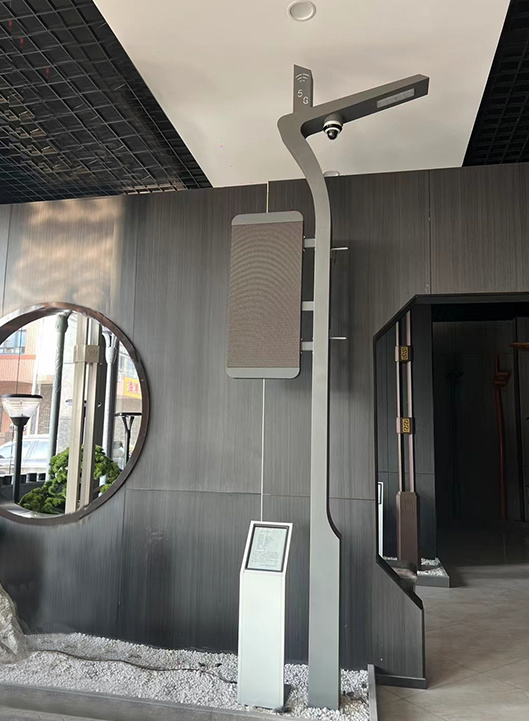
Technologies such as individual-lamp control, on-demand dimming, and remote monitoring are now mature, but their widespread adoption
Frequent cold snaps: sensors are easily obstructed by dust, and the communication module is in
Failure under extreme weather conditions and the existing electrical maintenance team’s lack of IoT maintenance capabilities.
The real barrier to entry for smart streetlights lies not in the chips, but in the maintenance system and
Training for technical personnel. Intelligentization is not as simple as just installing equipment;
Rather, it must be integrated into the capillaries of the city’s daily operations and maintenance.
Municipal street lighting serves as a mirror, reflecting the governance of urban public spaces.
its true level. What it requires is sustained investment and cross-departmental collaboration,
Professionalized maintenance—and a city’s baseline understanding of “nighttime safety.”

Guangdong Quanhui Lighting Co., Ltd. Founded in 2004, it is a comprehensive lighting enterprise integrating manufacturing, sales, and installation.
21 years of dedicated manufacturing: Municipal streetlights 、 Landscape lighting 、 Courtyard light 、 High-mast light 、 Smart Streetlights Outdoor landscape lighting project
Related News
Guangdong Quanhui Lighting Co., Ltd
Phone : 86-13726017260 Mr Li
WhatsApp:+86-18028366908
E-Mail: 18028366908.qh@gmail.com
Website : www.quanhuilight.com
Address of exhibition hall : cards 28, 29 and 30, building c, international street lamp city, guzhen town, Zhongshan city, Guangdong province
Factory address : No.17 and 18 Jiwei Avenue, Haizhou Xianlong Luo Sha Jiwei Industrial Zone, Guzhen Town, Zhongshan City, Guangdong Province
Leave us a message.