


















Smart Street Lighting: The Evolution from “Lighting the City” to “Sensing the City”
Author:
Source:
Release time:2026-03-24

Technical Core: Why Streetlights Have Become the Gateway to Smart Cities
Smart streetlights are not simply traditional lampposts with sensors added on.
At its core, it represents a paradigm shift in urban infrastructure.
Traditional streetlights serve solely the function of illumination, whereas smart streetlights
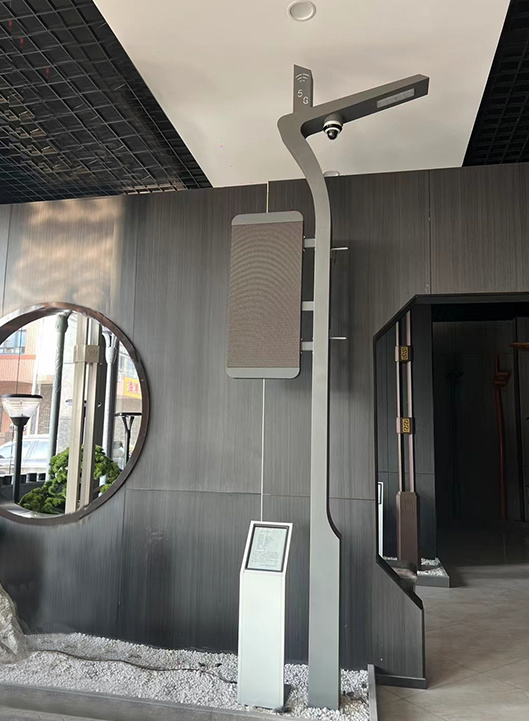
Integrates power, networking, sensing, and interactive capabilities into a single system.
Each lamppost can serve as an edge computing node, equipped with lighting,
Temperature and humidity, air quality, noise, traffic flow, facial recognition
and various other types of sensors, thereby forming the city’s neural network at the edge.

From a technical architecture perspective, smart streetlights comprise three layers: the perception layer.
(various sensors and cameras), network layer (fiber optics, 5G,
backhaul channels such as NB-IoT), and the platform layer (unified management
platform and data mid-end). Its core value lies in transforming the original
Discrete municipal infrastructure—lighting, traffic signage,
Security surveillance and environmental monitoring—integrated into a unified
Establish a data portal to prevent redundant urban excavation and fragmented construction.

Functional Reconfiguration: Composite Value Beyond Lighting
Lighting remains fundamental, but the methods of control have undergone a fundamental transformation.
Through the individual lamp controller and the IoT platform, on-demand implementation is possible.
Lighting: Automatically adjusts brightness based on pedestrian and vehicle traffic and time of day.
The energy-saving rate can exceed 50%. More importantly, the lamp post
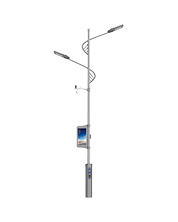
Becoming a platform that integrates multiple functions. In Shenzhen, Shanghai, and other cities
In practice, a single smart streetlight can integrate traffic signals,
Electronic traffic enforcement systems, 5G base stations, information display screens, public Wi-Fi,
More than ten features, including one-click emergency alert and electric vehicle charging stations.
The direct benefit of this integration is the release of urban space.

According to statistics, integrating multiple poles into one can reduce the number of roadside poles.
Reducing it by 30% to 40% has both lowered government administrative costs,
It also restores space to citizens. At the same time, the lampposts, as densely
Distributed power supply and networked nodes constitute 5G micro base stations.
The ideal platform for deployment, addressing 5G network coverage in
The key bottlenecks are the difficulty in securing site locations and the difficulty in obtaining power supply.

Data Dilemma: The Hidden Concerns Behind the Construction Boom
However, the development of smart streetlights has not been without challenges.
The industry is currently facing three challenges:
First, the boundaries of authority and responsibility are unclear. Whether streetlights fall under the jurisdiction of the housing and urban–rural development authorities or the urban management department is ambiguous.
The department responsible for traffic infrastructure is the traffic police, while 5G base stations are managed by China Tower.
The coordination mechanism among operators and multiple departments has not yet been fully streamlined.
Administrative barriers to cross-departmental data sharing still exist.

Second, the business model is not yet closed-loop. In the early stages of smart street lighting,
Investment far exceeds that of traditional streetlights, with the comprehensive construction cost per pole ranging from
Ranging from tens of thousands to over one hundred thousand yuan. Currently, most projects rely on
Government fiscal investment, operational revenue (advertising, charging,
Data services, among others, are still insufficient to cover the incremental costs.
Sustainable business models are still being explored.

Third, data privacy and security concerns. Streetlight poles
High-density deployments of cameras and facial recognition devices,
Involves boundaries for public-space data collection, as well as data storage and usage.
issues such as standardization. Without clear legal regulation,
This may raise public concerns about privacy infringement.

Evolutionary Direction: From Construction-Oriented to Operations-Oriented
The next phase of smart street lighting will shift from “how many units have been built”
Shift the focus to “what value has been created.” This requires city managers
Approach this from three aspects: establish cross-departmental urban lighting and pole management.
Management and coordination mechanisms; exploration of franchising, energy management services,
Diverse revenue models such as data operations; concurrently introducing public spaces
The detailed rules for the collection and use of data strike a balance between security and efficiency.
The true significance of smart streetlights lies not in how “intelligent” a single pole can be,
Rather, it hinges on whether it can make urban operations more efficient and enhance public spaces.
More pleasant, and enabling urban management to shift from experience-driven to data-driven.
This is not only a technological upgrade but also a profound transformation in urban governance philosophy.

Guangdong Quanhui Lighting Co., Ltd. Founded in 2004, it is a comprehensive lighting enterprise integrating manufacturing, sales, and installation.
21 years of dedicated manufacturing: Municipal streetlights 、 Landscape lighting 、 Courtyard light 、 High-mast light 、 Smart Streetlights Outdoor landscape lighting and illumination project.
Related News
Guangdong Quanhui Lighting Co., Ltd
Phone : 86-13726017260 Mr Li
WhatsApp:+86-18028366908
E-Mail: 18028366908.qh@gmail.com
Website : www.quanhuilight.com
Address of exhibition hall : cards 28, 29 and 30, building c, international street lamp city, guzhen town, Zhongshan city, Guangdong province
Factory address : No.17 and 18 Jiwei Avenue, Haizhou Xianlong Luo Sha Jiwei Industrial Zone, Guzhen Town, Zhongshan City, Guangdong Province
Leave us a message.