









Magnolia Landscape Lighting: Design Choices Between Formal Memory and Functional Reality
Author:
Source:
Release time:2026-11-10

The classic trade-off between weight and functionality
The visual archetype of the magnolia landscape lamp is almost instantly recognizable: five magnolia-shaped lampshades surround the light.
The framework stretches out, and the lamp posts stand tall like ceremonial guards. This architectural style dates back to Beijing in the late 1950s.
Originating from the magnolia lanterns in front of the Great Hall of the People, it has evolved into a large-scale tradition along the Nanjing Yangtze River Bridge.
It has become part of the collective memory through its application. Yet, under the weight of its classic status, it falls short in terms of functionality.
Long left uncleaned. Traditional magnolia lamps primarily use upward diffusion as their main lighting method, with a significant amount of light
Because they scattered into the night sky instead of landing on the pavement, the white magnolia lamps along the shores of West Lake in Hangzhou were gradually phased out.
Insufficient sealing between the lampshade and the lamp holder allows insects to enter, making it a persistent maintenance issue.
Rusting iron lamp posts and high energy consumption of light sources are shortcomings in municipal fine management.
They gradually take shape under the yardstick of management. Thus, the contemporary proposition of magnolia landscape lighting is not
The question is not whether to preserve the classics, but whether the classics can be functionally re-established.

Optical Path Reconstruction: A Technical Adjustment That Does Not Alter the Appearance
The key to breaking the deadlock lies in adjusting the position of the main light source. Nanjing Yangtze River Bridge
offers a highly instructive approach to restoration: the design team inlaid
LED light sources direct the main beam downward to provide roadway illumination, while the magnolia-shaped diffusers serve as secondary lighting.
The role is to provide only soft ambient lighting. This adjustment, without altering the appearance of the cultural relic,
This significantly reduces the power consumption of each lamp while concentrating the illumination more effectively on the road surface. Quzhou’s main thoroughfare. renovation of
It follows the same logic: retaining the classic magnolia design while fully replacing the light source with a high-efficiency one.
The LEDs have been optically optimized to provide soft, glare-free illumination, significantly improving standard road lighting levels.
Fine-tuning the position of light sources may seem like an engineering detail, but it actually reflects a shift in design thinking. Toward—The lampshade from
The “luminary” returns to being a “shaped form,” and the functionality of light and the symbolism of shape thus each take their proper place.

From Universal Symbols to Local Narratives
The deeper issue with magnolia landscape lighting lies in whether it can evolve from a standardized visual symbol.
A narrative medium that carries local memory: the “Tea and Zen Are One” magnolia lamps on Jiashan Avenue in Shimen, Hunan.
It offers a sample worth close reading: the lamp design retains the basic form of magnolia petals, but the leaves
Presented in the form of tea leaves, with the tea color enhancing regional identification; a laser engraving is added to the middle of the stem.
A lightbox inscribed with the words “Tea and Zen Share the Same Flavor” transforms the lighting fixture into a cultural emblem of Jiaoshan as the “Home of Chinese Tea and Zen.”
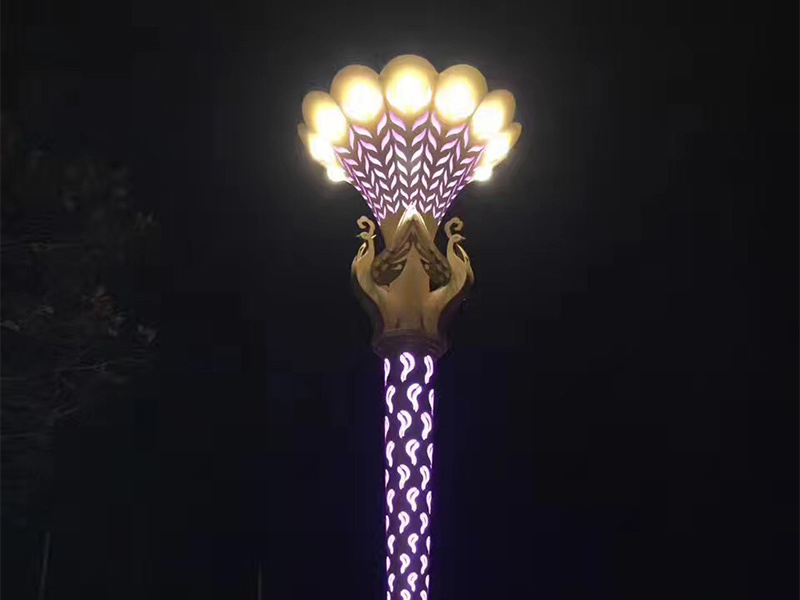
A nocturnal footnote to the pulse. In Baishui County, Weinan, the “Eight-Pronged Nine-Fire Phoenix Magnolia Lantern” integrates its base into…
Incorporating “Four Sages” cultural motifs and decorative script transforms a streetlamp into a repository of the county’s historical memory.
of miniature exhibition booths. The common insight from these practices is: the cultural expression of magnolia lamps
One should not dwell on the realism of the petals, but rather explore texture, pattern, and accompanying elements.
The localized design of components allows universal forms to develop a distinct regional character.

Conditions for the Persistent Presence of Classics
The longevity of magnolia landscape lighting ultimately depends on whether it can maintain its “unchanging form.”
Maintaining a balance with the “practical use of adaptation.” Its form carries the collective memory of generations’ relationship with the city.
The collective memory of a space—its value should not be easily discarded; yet the continuation of that memory…
It must not come at the expense of lighting quality and operational efficiency. When the luminous flux of a magnolia lamp…
It lands precisely on the road surface instead of scattering into the night sky, and its lampshade no longer becomes a trap for insects.
A dwelling, when its form engages in a genuine dialogue with the cultural fabric of its neighborhood, Classic
The form truly completes the translation from historical relic to contemporary facility. Magnolia landscape lamp
It illuminates not only the road but also the way a city engages with its own memory.

Guangdong Quanhui Lighting Co., Ltd. Founded in 2004, it is a comprehensive lighting enterprise integrating manufacturing, sales, and installation.
21 years of dedicated manufacturing: Municipal street lighting 、 Landscape lighting 、 Courtyard lamp 、 High-mast light 、 Smart streetlight Outdoor landscape lighting project
Previous Page
Previous Page
Related News
Guangdong Quanhui Lighting Co., Ltd
Phone : 86-13726017260 Mr Li
WhatsApp:+86-18028366908
E-Mail: 18028366908.qh@gmail.com
Website : www.quanhuilight.com
Address of exhibition hall : cards 28, 29 and 30, building c, international street lamp city, guzhen town, Zhongshan city, Guangdong province
Factory address : No.17 and 18 Jiwei Avenue, Haizhou Xianlong Luo Sha Jiwei Industrial Zone, Guzhen Town, Zhongshan City, Guangdong Province
Leave us a message.