














The Pole Is the City: The Terminal Logic of Smart Streetlights and Governance Consciousness
Author:
Source:
Release time:2026-10-06

From lighting fixtures to urban sensing terminals
The evolution of smart streetlights is, at its core, a redefinition of what a streetlight truly is.
The functional boundaries of traditional streetlights are clear and confined—they are solely responsible for illuminating the roadway. Meanwhile, smart…
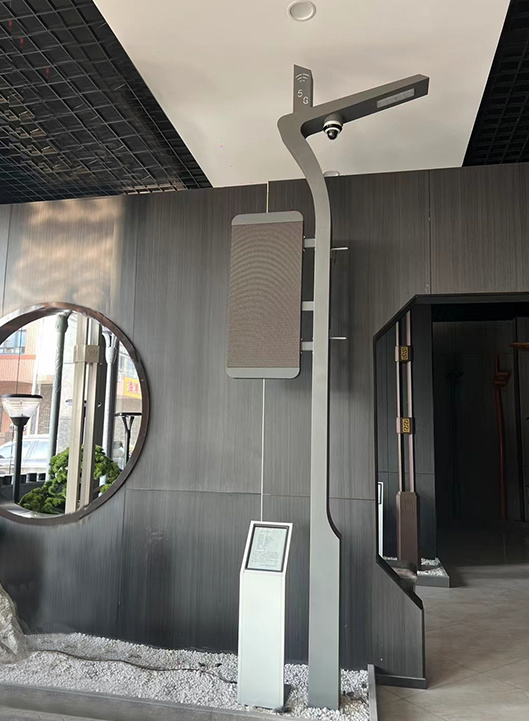
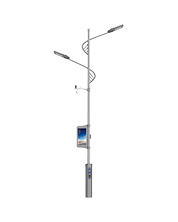
The advent of street lighting has completely blurred this boundary: a single light pole now simultaneously provides illumination,
With multiple functions such as monitoring, communication, sensing, and interaction, the urban Internet of Things has become a physical…
The sensory receptors and actuator nodes in space. The core logic underlying this shift in identity lies in:
Street lighting is the most widely distributed, densely concentrated, and reliably powered infrastructure in urban areas.
It naturally possesses the physical conditions to serve as an end node of the “urban nervous system.” When a streetlight…
No longer merely a light, it has become the physical cornerstone that enables urban governance to shift from “passive response” to “proactive sensing.”

The convergent logic of integrating multiple rods into one
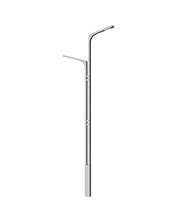
The most straightforward design innovation of smart streetlights is the “multi‑pole integration.” In the past, a single road…
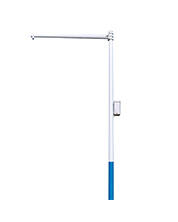
Standing side by side are various types of poles—lighting poles, surveillance poles, traffic signal poles, street sign poles, and more—each serving its own purpose.
In governance, repeated excavation is undertaken. The design rationale of the smart integrated pole is to consolidate these functions into a single, compact unit.
On the same pole, the accompanying cabinet is integrated into a single unit, thereby freeing up roadside space.
Practical experience in Guangzhou’s Pazhou West Area indicates that integrating multiple poles into a single structure can reduce roadside pole infrastructure by approximately…
Thirty to forty percent, The city skyline consequently becomes more streamlined. Yet this convergence is far from simple.
physical superposition, Rather, it requires designers to consider the pole’s structural design, load-bearing capacity, and power supply.
Architecture, Communication protocol Conduct a systematic re-planning at all levels. Every inch of the pole…
Space, every single one The cable routing pathways and the provisions for each equipment cabinet all require…
Leave interfaces open for future functional expansion during the design phase.

The Underlying Philosophy of Power Supply Architecture
The underlying technical logic of smart streetlights is embedded within their power-supply architecture. Conventional streetlights employ…
AC power supply, while DC power‑supply technology is reshaping this landscape. A pilot project in Guangzhou’s Pazhou district.
The project employs a dual-voltage architecture of “110V + 48V”: 110V powers high‑power lighting, while 48V serves as…
Low-power terminal power supply both reduces line losses and ensures compatibility with future IoT devices.
expansion requirements. More importantly, when paired with energy storage systems, the DC system can operate during mains power outages.
It ensures the basic operation of streetlights, surveillance cameras, and traffic signals, transforming streetlights from mere electricity consumers.
The equipment is transformed into a node of urban infrastructure with emergency response capabilities. A transformation of the power supply architecture.
Though it may seem basic, it determines whether smart streetlights can truly serve as “urban terminals.”
Character — none Without a reliable power infrastructure, no smart functionality can even be considered.

From single-point intelligence to closed-loop autonomy
The intelligent evolution of smart streetlights is undergoing a leap from “point‑based algorithms” to “closed‑loop autonomy.”
Early smart dimming relied on preset time‑based strategies, whereas today’s technological approach integrates radar.
Sensing and AI algorithms enable dynamic responsiveness—lights turn on when a vehicle approaches and dim when the vehicle departs. Going a step further…
Moreover, AI agents have been integrated into the lighting management system, establishing a “perception–decision–execution” loop.
A complete closed-loop of “operation–optimization” enables the streetlight system to perform autonomous analysis and self‑scheduling.
Rather than passively waiting for human instructions, this closed-loop autonomous capability offers benefits that extend beyond energy efficiency.
In essence, it means that urban lighting systems are beginning to develop a certain degree of “environmental adaptability.”
It can continuously optimize its operational state without human intervention.

The pole is a metaphor for the city.
Ultimately, the true test of smart streetlights lies in how designers and administrators conceptualize “urban infrastructure.”
The depth of understanding. A single smart streetlight pole carries not only the function of illumination but also serves as a cornerstone for the city.
The ability to perceive its own operational status, the capability to allocate public resources, and the responsiveness to citizens’ needs
its responsiveness. When every streetlight becomes a node in the city’s neural network, the city…
The governance logic thus shifts from “centralized radiation” to “edge computing”—decision-making no longer…
It does not rely entirely on a remote platform, but rather occurs partially on the pole itself. This distributed approach…
Intelligence Its architecture may well be the most fundamental insight that smart streetlights offer for urban governance.

Guangdong Quanhui Lighting Co., Ltd. Founded in 2004, it is a comprehensive lighting enterprise integrating manufacturing, sales, and installation.
21 years of dedicated manufacturing: Municipal streetlights 、 Landscape lighting 、 Courtyard light 、 High-mast light pole 、 Smart streetlight Outdoor landscape lighting project
Previous Page
Previous Page
Related News
Guangdong Quanhui Lighting Co., Ltd
Phone : 86-13726017260 Mr Li
WhatsApp:+86-18028366908
E-Mail: 18028366908.qh@gmail.com
Website : www.quanhuilight.com
Address of exhibition hall : cards 28, 29 and 30, building c, international street lamp city, guzhen town, Zhongshan city, Guangdong province
Factory address : No.17 and 18 Jiwei Avenue, Haizhou Xianlong Luo Sha Jiwei Industrial Zone, Guzhen Town, Zhongshan City, Guangdong Province
Leave us a message.