










The Discipline of the Beam: The Directional Logic of Outdoor Floodlights and Engineering Ethics
Author:
Source:
Release time:2026-11-19

The Essence of Projection: From Uniformity to Selection
The distinction between outdoor floodlights and general lighting fixtures does not lie in their power rating or mounting height,
Rather, it makes a clear commitment to the directionality of light. Floodlights aim to illuminate an entire area
They light up evenly, whereas floodlights aim to make a specific subject visible and emphasized,
To be understood. This functional positioning determines that the core of floodlight design is “selection.” Select
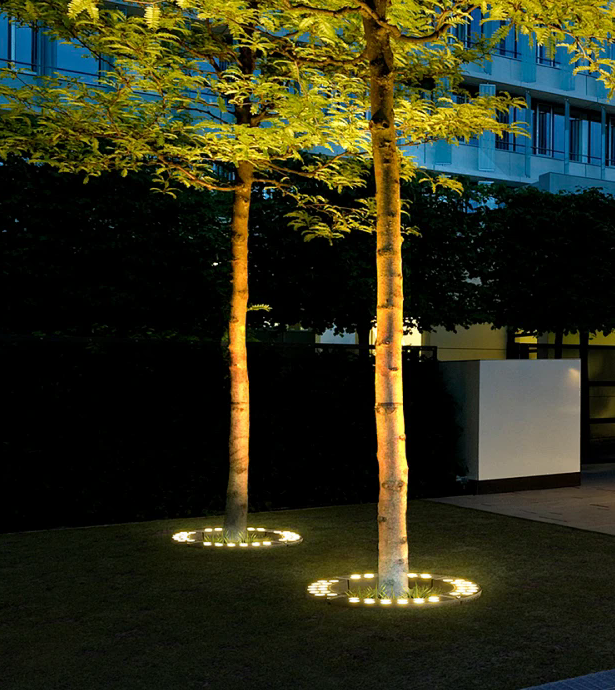
What to illuminate, Choose from which angle to illuminate, and decide where the light should end. Building facade
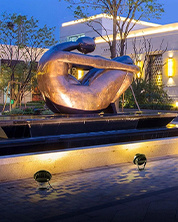
of hierarchy, The scale of the sculpture and the visual focal point of the landscape node are both determined by This bouquet has been carefully Constrained
Defined by light. The professionalism of floodlights is first and foremost reflected in the prudent exercise of this choice.

Optical Boundaries: Occlusion Angle and Spill Light
The design depth of a floodlight lies in its ability to control where the light ends.
The setting of the light shield angle constitutes the first line of defense in this control—shielding the light emitted from the luminaire’s aperture.
The structure prevents the light source from being viewed directly at normal viewing angles, thereby keeping glare within acceptable limits.
It is within the acceptable range. However, a more fundamental issue than glare control is managing light spill.
If a floodlight directs a significant portion of its light energy beyond the intended target, it not only results in wasted energy,
It is more likely to disturb the surrounding environment and pedestrians’ vision. The ethics of directional projection lie precisely in this: directing light
Delivering to where it should go is competence; stopping the light where it shouldn’t go is discipline.
Excellent lighting design seeks a sharp transition at the edge of the light spot and on the target surface.
Uniform coverage, rather than illuminating the surroundings “incidentally” with a wide beam.

Heat and Dust: Optical Attenuation in the Temporal Dimension
The performance of a floodlight is not determined at the moment of installation, but rather over three years,
It is still tested after five years. If the heat from the LED light source cannot be effectively dissipated, the chip
An increase in junction temperature accelerates lumen depreciation, causing the luminaire to lose its original designed brightness without the user noticing.
The rationality of the heat dissipation structure—the orientation of the cooling fins, the unobstructed flow channels,
Thermal conductivity of the lamp housing material is the engineering foundation that determines whether a floodlight can stand the test of time.
Another often underestimated factor is dust accumulation: in outdoor environments, dust buildup on the surface of luminaires can Directly weaken
Light extraction efficiency, and degrades the spot shape. Featuring self-cleaning capabilities Surface treatment and
The maintenance-friendly structural design ensures that the floodlight maintains its performance over long-term use. Optical quality
Stability. It is precisely these unseen details that truly define the professionalism of floodlights.

Who is bearing this beam of light?
The dimension most easily overlooked in floodlight design is the impact of light on non-target individuals.
A floodlight illuminating a sports field or billboard, whose user is inside the venue and bears the impact
But it could be in a residential building hundreds of meters away. When the design only considers “illuminating the target”
And without asking “who is being disturbed by the light,” floodlights slip from being lighting tools to becoming sources of light pollution.
The significance of precise illumination is thus twofold: it is both a respect for the subject being lit,
It is also a responsibility to the surrounding environment. A disciplined beam of light knows its own boundaries.
Where—this is both an optical issue and a matter of design ethics.

Guangdong Quanhui Lighting Co., Ltd. Founded in 2004, it is a comprehensive lighting company integrating manufacturing, sales, and installation.
21 years of dedicated manufacturing: Municipal street lighting 、 Landscape lighting 、 Courtyard lamp 、 High-mast light 、 Smart streetlight Outdoor landscape lighting project
Previous Page
Related News
Guangdong Quanhui Lighting Co., Ltd
Phone : 86-13726017260 Mr Li
WhatsApp:+86-18028366908
E-Mail: 18028366908.qh@gmail.com
Website : www.quanhuilight.com
Address of exhibition hall : cards 28, 29 and 30, building c, international street lamp city, guzhen town, Zhongshan city, Guangdong province
Factory address : No.17 and 18 Jiwei Avenue, Haizhou Xianlong Luo Sha Jiwei Industrial Zone, Guzhen Town, Zhongshan City, Guangdong Province
Leave us a message.